

Description
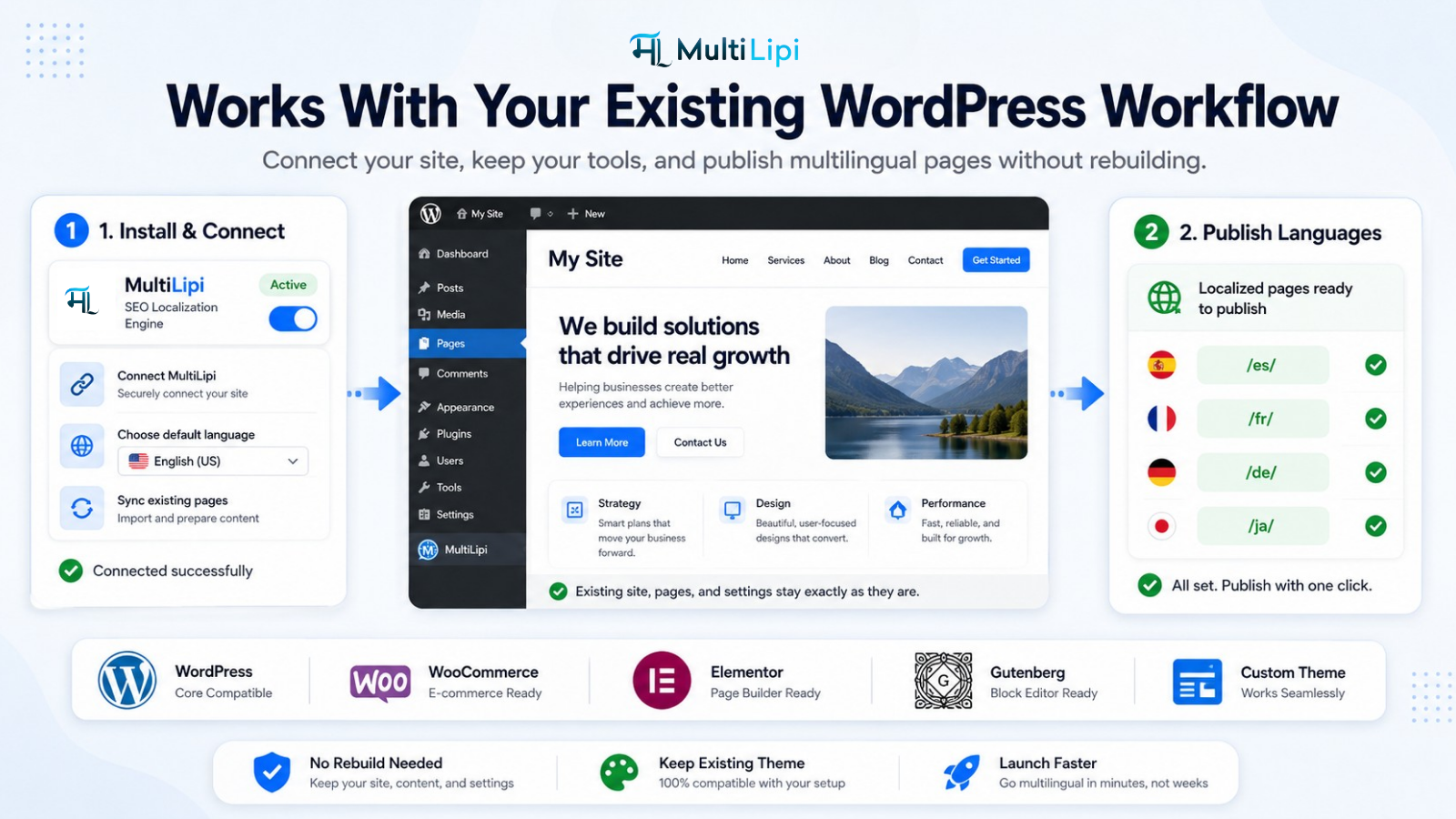
MultiLipi Translate fetches permitted languages from the MultiLipi backend, keeps the API key on the WordPress server, and renders target-language public pages with translated HTML before they are sent to visitors or crawlers.
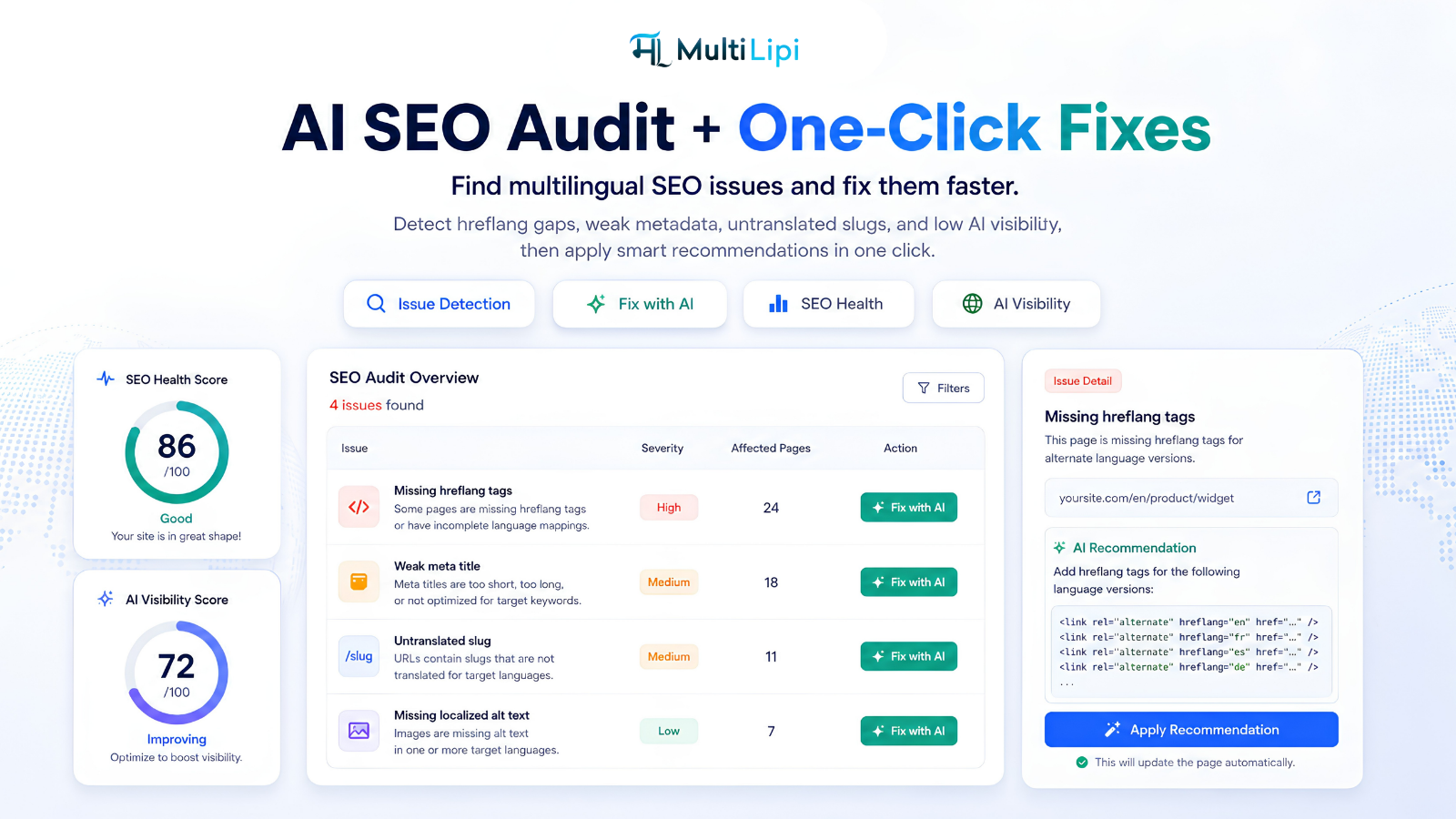
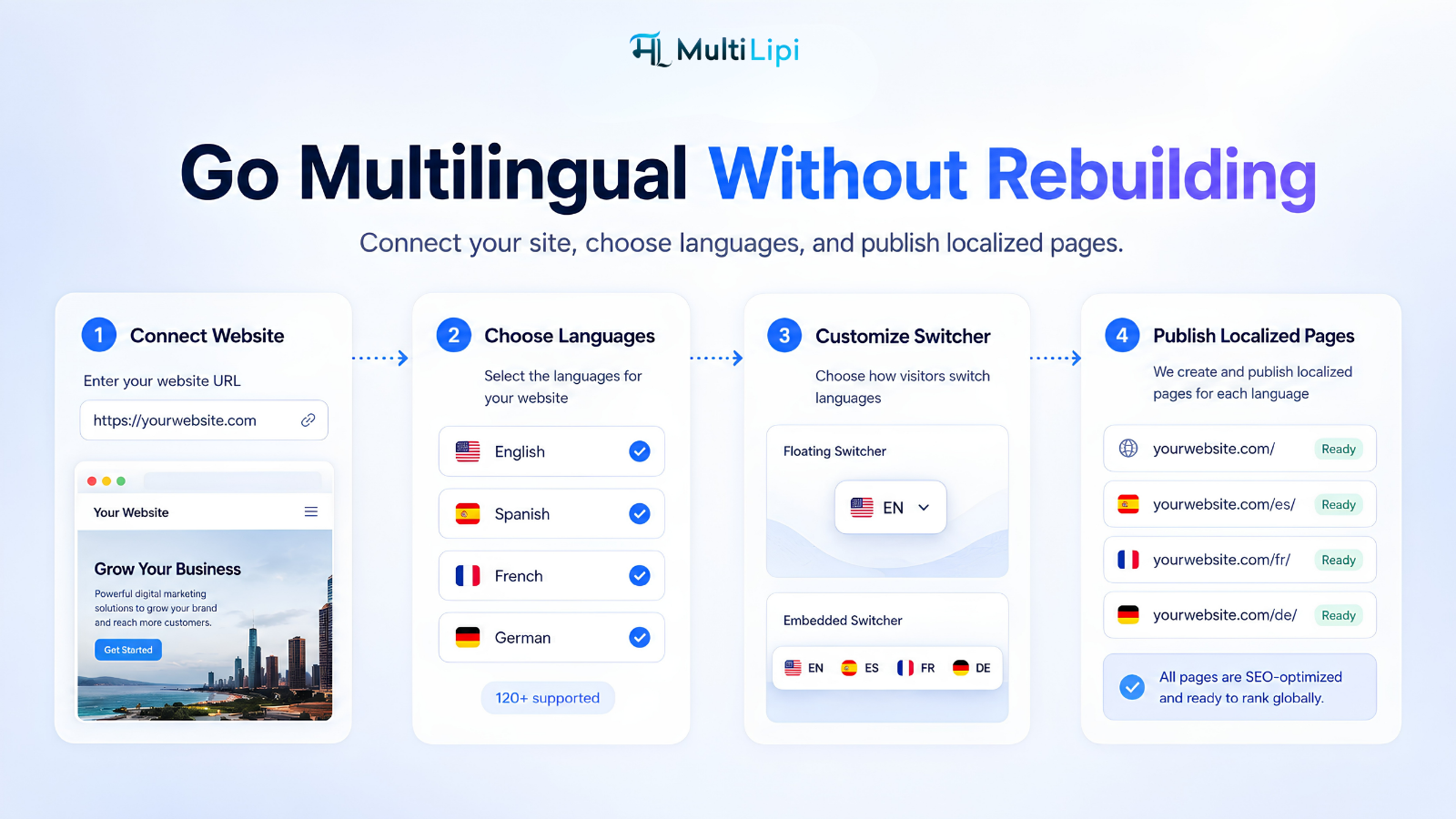
Features include language subdirectories, routing for standard WordPress URLs and public custom post types, WooCommerce product/store URL compatibility, hreflang output, an SEO Pack with manual target-language metadata fields and an optional multilingual sitemap, server-rendered text and social metadata translation, an automatic floating language switcher plus shortcode, conditional language-content shortcodes, API-managed language storage and redirects, a central local slug-translation editor, indexed target-language WordPress search with optional on-demand and visitor-driven modes, server response caching, API-enabled language-subdirectory llms.txt plus public-page .md files using the existing saved MultiLipi API key, and API-enabled best-effort LLM request analytics.
The source project includes separate README and feature-inventory documentation. The upload ZIP intentionally contains runtime plugin files only.
Bundled libraries
Flag icons use flag-icons 6.6.6 by Panayiotis Lipiridis (MIT license). The CSS and SVGs are served locally from this plugin. The license is included at assets/vendor/flag-icons/LICENSE.
Screenshots



Installation
- Upload the plugin folder to
/wp-content/plugins/or install its ZIP in WordPress. - Activate MultiLipi Translate.
- Open MultiLipi > Settings, enter an API key, and fetch language settings.
- Enable target languages and save.
Reviews


Contributors & Developers
“Translate Website & Rank Globally with SEO & GEO – MultiLipi AI Translation” is open source software. The following people have contributed to this plugin.
Contributors
“Translate Website & Rank Globally with SEO & GEO – MultiLipi AI Translation” has been translated into 2 locales. Thank you to the translators for their contributions.
Interested in development?
Browse the code, check out the SVN repository, or subscribe to the development log by RSS.
Changelog
3.0.14
- Restore WordPress.org updates for the standard MultiLipi plugin and remove the custom updater from its distribution.
- Keep customer update services exclusive to configured white-label packages.
3.0.13
- Make disabling caching bypass saved public translations as well as temporary response, page and browser caches, and pause background page preparation and recovery.
- Show the installed plugin version first in diagnostics and label the diagnostic schema version explicitly.
- Update English and Japanese cache-setting descriptions to match cache-off behavior.
3.0.12
- Add mlms_debug=1 to show the installed plugin version, safe effective settings, and translation diagnostics.
- Make mlms_test_translation=1 bypass local page, response, saved-string, and browser translation caches for one request without clearing existing data.
- Preserve background translation and recovery storage while using the new diagnostic mode.
3.0.11
- Apply dashboard HTML block edits on translated pages: hide, replace inner HTML, insert before, and insert after.
- Consume existing API HTML overrides, protect edited blocks from retranslation, and retain edits in page and browser caches with bounded metadata freshness.
- Include the block runtime in all white-label packages.
3.0.10
- Update the white-label translation, configuration, slug synchronization, analytics and LLM API origin to live-js.multilingual-live.com.
3.0.9
- Route all bundled white-label service APIs through reactapi.multilingual-live.com, including translation, configuration, slug synchronization, analytics and LLM generation. Keep API requests on the configured host without following redirects.
3.0.8
- White-label packages use partner names throughout their interface, including sitemap URLs, shortcode instructions, admin page URLs and cache labels. Existing sitemap URLs, shortcodes and admin bookmarks remain supported.
3.0.7
- Store public translations in an indexed local table and reuse them even when temporary response/page caching is off. Import matching legacy dictionaries without changing their saved wording.
- Reuse unchanged body text after title or schema changes; refresh page enhancements separately with a small context probe.
- Separate Clear page cache from Refresh saved translations. Manual slugs and SEO overrides are retained by both actions.
- Recognize explicit per-string API outcomes, retain completed work, and retry pending strings without caching them as successful translations. Limit reuse of unconfirmed unchanged results from older API responses.
- Keep personalized additions out of shared caches and preserve logged-in access to saved public translations.
- Recover incomplete public translations independently of temporary caching, with one recovery worker per site and bounded retries.
3.0.6
- Fix public translated Markdown routes returning 404 when HTML translation caching is disabled. Generated documents now own their rendering and cache headers; private pages remain excluded.
- Send public JSON-LD to the schema translation API when enabled, retaining original entity identities, product facts and manually translated URLs.
- Synchronize schema language and page metadata with the translated page, localize URL arrays and add translation annotations when LLM optimization is enabled.
- Preserve schema and media response data when reusing cached translation strings.
3.0.5
- Preserve cached title, description and body translations when missing text in the same API batch fails.
- Retry incomplete public pages with signed, cookie-free background requests, independently of bulk pretranslation. Deduplicate jobs and limit retries with a cooldown.
- Use a complete matching public-page fallback when available. Otherwise send a temporary 503 with Retry-After; translation failures no longer add noindex or remove canonical metadata.
- Keep unreviewed languages out of indexing, hreflang and sitemaps after upgrades. Retain confirmed indexing selections during configuration refreshes.
- Forward translation diagnostic request IDs to the API for latency investigation.
3.0.4
- Hide Background pretranslation controls and the URL recovery menu. Existing background settings and automatic preservation of saved v2 URLs remain in effect.
- Add Language directory base path in Settings. Use /blog/ to translate /blog/article/ at /blog/fr/article/, or keep / for the current whole-site URL structure.
- Apply the configured path to routing, manual slug resolution, translated links, language switching, canonical/hreflang URLs, multilingual sitemaps and translation API context. Pages outside that path retain their source URLs.
- Preserve existing WordPress installation paths and saved slug mappings. Validate directory settings and refresh rewrite rules and sitemap caches when the path changes.
3.0.3
- Restore per-language Directory routing controls in the production settings page. Choose WordPress source routing, MultiLipi ownership, or Hybrid routing for an existing language path.
- Keep language availability and indexing controls in sync when changing a directory’s routing policy. Existing saved policies, protected WordPress paths and Hybrid SEO publication checks remain in effect.
3.0.2
- Preserve unambiguous v2 full-path mappings for the same connected account, including translated store bases. Keep original storage and report unsafe or conflicting entries in URL recovery.
- Add an Allow indexing choice for each active language. Unpublished languages remain accessible with noindex and are excluded from hreflang and multilingual sitemaps. Configuration refreshes preserve publication choices.
- Translate actual page titles, descriptions and social metadata rather than substituting generated API metadata. Explicit local SEO overrides retain priority.
- Keep public text translations in persistent local storage so unchanged strings survive normal page-cache invalidation. Logged-in visitors can reuse these strings without storing their personalized additions there.
- Bound foreground translation work to 12 seconds and prevent simultaneous duplicate requests for missing page translations. Existing degraded responses remain noindex and uncached if translation cannot finish.
- Make background pretranslation available in Settings for preparing page content before visitors arrive. It is opt-in, uses the connected account’s translation quota, and depends on WordPress cron and loopback requests.
- Hide Hybrid directory SEO controls when no active language uses Hybrid routing. Preserve existing saved routing choices.
- Clear cache removes persistent text translations as well as temporary responses and HTML. Use it after editing translations in the dashboard; other page caches/CDNs need their own purge.
3.0.1
- Avoid early textdomain loading from packaged switcher defaults and background-job hook registration on WordPress 6.7 and later.
- Translate background progress labels when jobs run, preserving the original hook priorities and translated admin labels.
3.0.0
- Retain the multilipi-multilingual-seo folder, entry filename, and self-hosted update channel for in-place upgrades from v2.
- Automatically preserve the saved API key, source/target languages, selected languages, and API feature flags without reactivation.
- Refresh newer API configuration fields in a bounded background job; preserve local configuration if the service is unavailable.
- Preserve multilingual sitemap discovery and redirect old admin and sitemap entry points.
- Leave v2 slug mappings untouched and do not import them into v3.
0.7.6
- Simplify settings to the API key, target languages, and five SEO/search options; manage translation, slug, LLM, and usage behavior from fixed policy or API capabilities.
- Support session language storage for none, persistent cookies for dynamic_translation and language_redirection, and redirects for language_redirection.
- Restore a saved language on revisited source pages in place when dynamic translation is enabled; manual selections always navigate to language subdirectories.
- Honor use_dynamic_translation for browser text updates and dynamic content while preserving server rendering and page-view reporting.
0.7.5
- Move Settings and Slug translations into a top-level MultiLipi admin menu using the original MultiLipi icon.
- Refresh the settings page with grouped controls, connection and language sections, and responsive styling.
- Keep settings notices, language-switcher previews, and admin actions working at the new menu location.
0.7.4
- Repair the production settings-profile rendering path so packaged plugins pass PHP parsing and activate normally.
- Keep hidden production-profile settings and directory-routing choices intact when administrators save visible settings.
0.7.3
- Fix plugin deletion when WordPress runs uninstall cleanup without loading the main plugin bootstrap.
- Cache-bust browser translation assets after updates and recover safely from transient or expired translation-session tokens.
- Add an explicit per-row Remove control to the Slug translations editor.
0.7.2
- Make language-switcher button, dropdown, and hover colors consistently use the configured theme tokens across the catalog.
- Keep automatic floating switchers at their configured position from first render, and correctly mount automatic embedded switchers at their configured target.
0.7.1
- Build target-language URLs from the canonical source-site URL so a source language other than English cannot produce nested directories such as
/en/en-gb/. - Save the expanded language-configuration response, including switcher data, URL filter rules, and class-only block exclusions.
- Exclude matching target routes from translation, generated links, hreflang, sitemap, search, REST, and LLM/Markdown output; choose a 404 or temporary source-URL redirect in Settings.
- Treat each
exlclude_attributevalue as a class name only, and invalidatellms.txtcache entries when URL filter rules change. - Add per-language directory-routing policies: keep native source routing, let MultiLipi claim the directory, or use native-first hybrid fallback after a confirmed native 404 on WordPress 6.1+. Policies can also be selected manually for custom routes WordPress cannot detect; protected WordPress directories remain source-only.
- Add a default-on setting to publish or suppress hybrid URLs in hreflang and the MultiLipi XML sitemap without changing their visitor routing.
0.7.0
- Add an opt-in administrator-only LLM diagnostics panel showing bounded, redacted upstream API request and response excerpts without exposing the saved API key or visitor data.
- Add a Settings switch to bypass stored
llms.txtand Markdown responses. Disabled-cache responses useno-storeheaders while retaining generation locks and rate limits. - Restrict
llms.txtdiscovery to enabled language subdirectories and add target-home Markdown aliases:/hi/.md,/hi.md, and/hi/index.html.md. - Resolve translated-slug and
index.phpMarkdown routes back to their source-side path, and remove public no-translation/switcher regions before sending locally rendered HTML to the Markdown service. - Add opt-in LLM request analytics for anonymous public WordPress responses when the fetched backend configuration enables
is_llmsoris_schema. - Send the backend-compatible bot-family classification, source domain/path, language, response status, latency, and bounded raw User-Agent to the separate unauthenticated telemetry endpoint; no API key, cookie, IP address, query string, page content, or request body is sent.
- Deliver telemetry only after PHP-FPM has completed the visitor response, with a bounded single in-flight request and outage cool-off; hosts without a safe after-response primitive skip analytics.
- Add strict normalization for backend LLM/schema flags, so string values such as
noandfalsedo not accidentally enable the feature.
0.6.0
- Add opt-in server-side language-subdirectory
llms.txtand public Markdown routes, including/{language}/llms.txt,/about.md,/hi/.md,/hi.md, and/hi/index.html.md. - Use the existing saved MultiLipi API key as the server-side Bearer token for LLM/Markdown generation; no separate LLM key is stored or exposed.
- Add bounded caching, single-flight generation, rate limits, lifecycle regeneration, and privacy exclusions for generated LLM files.
0.5.11
- Emit portable query-form child sitemap URLs so nginx hosts that intercept unknown XML files cannot return a server-level 404 before WordPress runs.
0.5.10
- Prevent SEO-plugin URL hooks from printing duplicate raw canonical/Open Graph URLs into translated page heads.
- Make multilingual sitemap child URLs work before rewrite rules are refreshed and add the MultiLipi sitemap index to compatible sitemap indexes, including Rank Math.
0.5.9
- Add an SEO Pack that safely localizes standard canonical, Open Graph/Twitter URL, and semantic page JSON-LD output alongside common SEO plugins.
- Add manual target-language SEO title, description, Open Graph, and Twitter overrides for public posts, products, custom post types, and terms.
- Add an off-by-default multilingual XML sitemap with hreflang alternates, advertised alongside existing WordPress/SEO-plugin sitemaps.
0.5.8
- Decode valid percent-encoded UTF-8 text before writing translated document titles, descriptions, and social metadata, so browser tabs display readable target-language text.
0.5.7
- Add an off-by-default Visitor-driven search index that translates and stores only a public target-language post/product a visitor actually opens, without queueing cron or bulk-pretranslating the site.
0.5.6
- Add an off-by-default, backend-authorized and rate-limited on-demand source-language search fallback for target-language queries with no local translated-index match.
0.5.5
- Server-render initial target-language HTML for explicitly enabled logged-in visitors, with private/no-store response headers to protect personalized pages from shared caches.
0.5.4
- Show WordPress percent-encoded Unicode localized slugs as readable text in the Slug translations editor while retaining their safe internal URL form.
0.5.3
- Translate mixed search labels such as “Search results: “हुडी”” while keeping the visitor-entered target-language term out of API requests.
- Add opt-in Background pretranslation. It is off by default, so pages and automatic slugs are translated on eligible visitor visits rather than queued for cron.
0.5.2
- Add a nonce-protected Settings action to permanently delete all MultiLipi data for the current site.
- Delete all plugin-owned settings, caches, queued jobs, slug mappings, and translated-search tables automatically on uninstall, including every site in a multisite network.
0.5.1
- Keep Gutenberg and other recognized GET search forms inside the active language directory instead of submitting to the source-language home URL.
0.5.0
- Add conditional language-content shortcodes, including safe migration aliases when no other plugin owns them.
- Add an opt-in, browser-only language redirect for first visits to the source home page; explicit switcher choices are remembered.
- Translate existing Open Graph/Twitter title and description fields server-side, translate visible select/button controls, honor common no-translation markers, and translate only genuinely new dynamic element subtrees after a server-rendered page.
0.4.0
- Fix translated WooCommerce product slugs and generic public custom-post-type routes by replaying WordPress’s viewable CPT query handling after the language directory is removed.
- Add WooCommerce compatibility for product-search actions, Cart/Checkout/My Account URLs and supported endpoints, same-origin Woo AJAX URLs, return redirects, cart-item links, and safely targeted fragment translation.
- Add plugin-neutral canonical/Open Graph URL normalization for standard SEO-plugin head output.
0.3.1
- Add Settings > Slug translations: a searchable, paginated editor for local post/page/CPT and taxonomy-term translated slugs by target language.
0.3.0
- Add opt-in local automatic slug translation for published posts, public custom post types, and public terms through queued jobs or a safe first eligible, query-free target-language GET visit, while preserving manual slug overrides and collision protection.
- Add opt-in indexed multilingual WordPress search for translated post titles and content on target-language search pages.
0.2.2
- Preserve WordPress static front-page routing under a language directory instead of falling back to the configured posts page.
0.2.1
- Rewrite same-site and root homepage links emitted directly by themes and builders into the active language directory.
0.2.0
- Render target-language pages with translated HTML before sending the page to visitors.
0.1.2
- Fix persistence of fetched language configuration after saving or reloading Settings.
0.1.1
- Show the fetched, key-free backend language configuration directly in Settings.
- Add an automatic public floating language selector and improve shortcode placement guidance.
0.1.0
- Initial MultiLipi API integration.